Solar Farms Make Good Neighbors
Modern solar farms are quiet, safe, and are often the neighbor you don't notice.

Modern solar farms are quiet, safe, and do not create significant glare. Although they do modify the view of a landscape, they create no air or water pollution and have not been found to significantly impact local property values.
Solar Energy Health and Safety
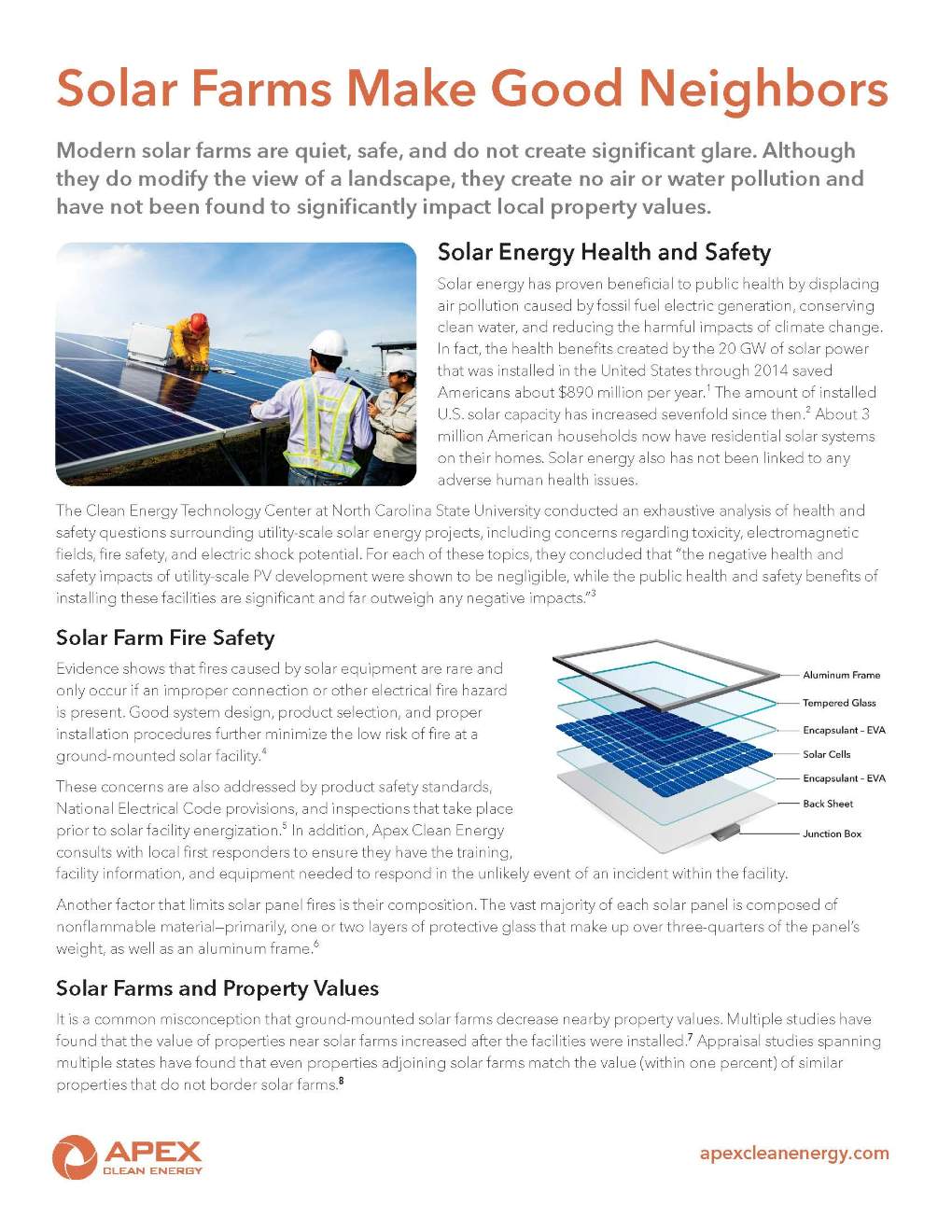
Solar energy has proven beneficial to public health by displacing air pollution caused by fossil fuel electric generation, conserving clean water, and reducing the harmful impacts of climate change. In fact, the health benefits created by the 20 GW of solar power that was installed in the United States through 2014 saved Americans about $890 million per year.1 The amount of installed U.S. solar capacity has increased twelvefold since then.2
About 3 million American households now have residential solar systems on their homes. Solar energy also has not been linked to any adverse human health issues.
The Clean Energy Technology Center at North Carolina State University conducted an exhaustive analysis of health and safety questions surrounding utility-scale solar energy projects, including concerns regarding toxicity, electromagnetic fields, fire safety, and electric shock potential. For each of these topics, they concluded that “the negative health and safety impacts of utility-scale PV development were shown to be negligible, while the public health and safety benefits of installing these facilities are significant and far outweigh any negative impacts.”3
Solar Farm Fire Safety
Evidence shows that fires caused by solar equipment are rare and only occur if an improper connection or other electrical fire hazard is present. Good system design, product selection, and proper installation procedures further minimize the low risk of fire at a ground-mounted solar facility.4
These concerns are also addressed by product safety standards, National Electrical Code provisions, and inspections that take place prior to solar facility energization.5 In addition, Apex Clean Energy consults with local first responders to ensure they have the training, facility information, and equipment needed to respond in the unlikely event of an incident within the facility.
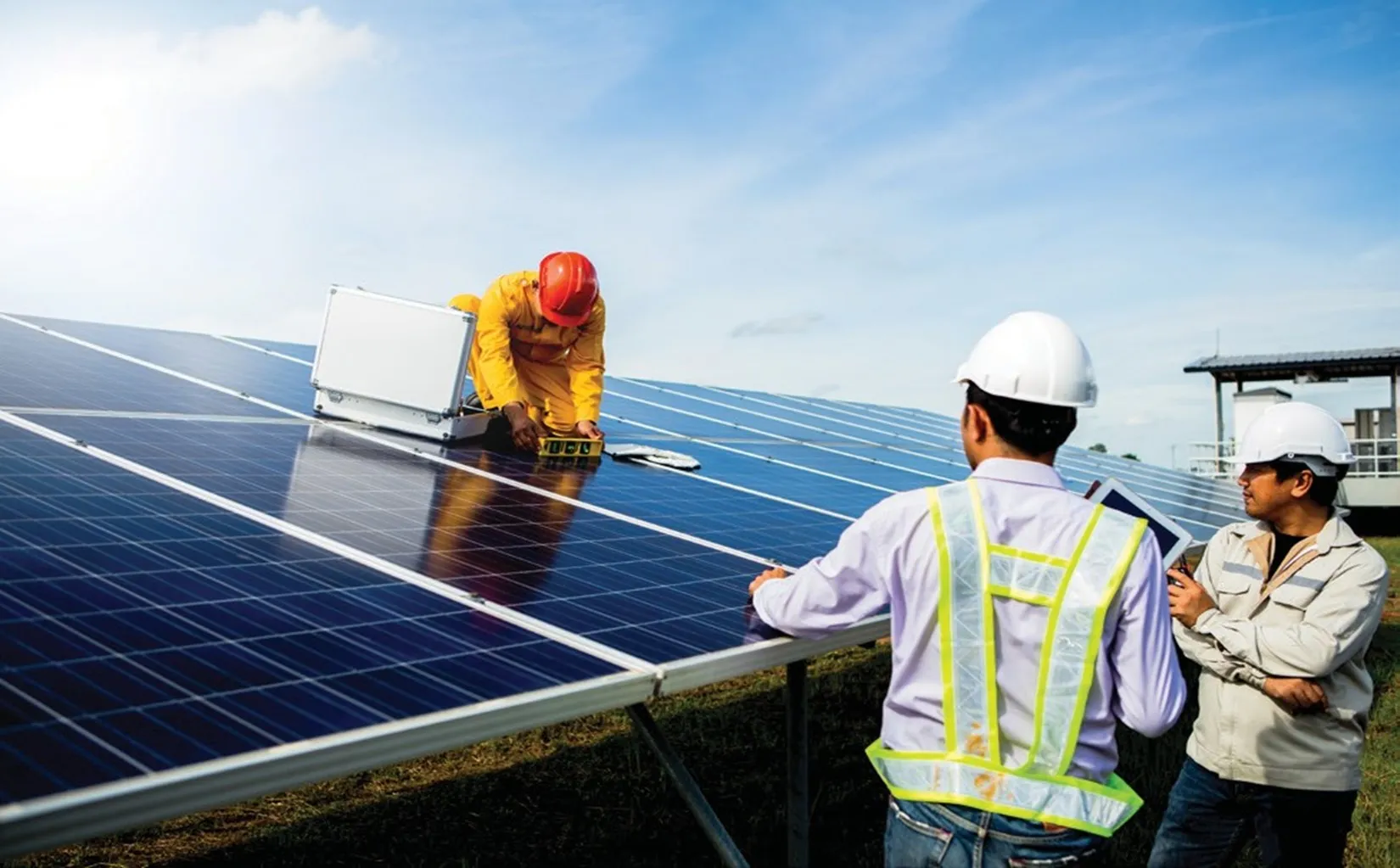
Another factor that limits solar panel fires is their composition. The vast majority of each solar panel is composed of nonflammable material—primarily, one or two layers of protective glass that make up over three-quarters of the panel’s weight, as well as an aluminum frame.3
Solar Farms and Property Values
It is a common misconception that ground-mounted solar farms decrease nearby property values. Multiple studies have found that the value of properties near solar farms increased after the facilities were installed.6 Appraisal studies spanning multiple states have found that even properties adjoining solar farms match the value (within 2%) of similar properties that do not border solar farms.
The positive correlation between utility-scale solar projects and nearby property values could be due to the new tax revenues, which are often used to support local schools and other public services, as well as the local employment opportunities that utility-scale solar projects can provide.7
Solar Farms and Sound
Solar panels have no moving parts, aside from slow-moving tracking systems that orient the panels during the day to face the sun, so they do not produce any sound on their own.
Inverters on a solar farm convert direct current (DC) electricity generated by a solar panel into alternating current (AC) electricity that is used for our power supplies. The inverters, an integral component of the solar facility, generate a very low-decibel “hum” during daytime operations. Fortunately, the impact of this sound is negligible because the equipment is strategically placed in the center of the facility, hundreds of feet from residences, to allow the sound to naturally dissipate.
A study by the Massachusetts Clean Energy Center measured sound from inverters at various distances and found the sound they produce is negligible and becomes completely inaudible at 50 to 150 feet away.8 If needed, inverter sound can be further controlled by insulating the inverter with soundproofing material, shielding the inverter with landscape plantings, or moving the inverter farther away from homes or businesses. Inverters used at solar facilities are subject to performance standards established by the Institute of Electrical and Electronics Engineers (IEEE) and Underwriters Laboratories (UL), which ensure that inverters do not generate excessive noise or harmonics that can affect the power grid.9
Solar Farms and Glare
Solar panels are designed to absorb sunlight and minimize reflection, as any light reflected by the panels cannot be converted into electricity. Modern PV panels reflect as little as 2% of the light that strikes them, a value that is lower than that of grass, water, crops, or snow.10 According to the FAA’s 2018 Airport Solar Guide, solar photovoltaic systems are “designed to absorb sunlight (rather than reflect it), minimizing potential impacts of glare.”11 Since 2010, more than 20% of U.S. airports have adopted on-site solar power, providing further evidence that solar panels do not produce significant glare.12

"The negative health and safety impacts of utility-scale PV development were shown to be negligible, while the public health and safety benefits of installing these facilities are significant and far outweigh any negative impacts.”—Clean Energy Technology Center at North Carolina State University (2026)